


All-in-One Diesel Air Heater with Four Outlets: A 12V 5KW Parking Heater for Trucks, RVs and Work Vehicles

A cold cab costs more than comfort. Drivers idle the engine for hours to stay warm. Idling burns fuel, adds engine wear and makes noise at night. A parking heater solves this problem in a different way: it burns a small amount of diesel in its own combustion chamber and sends warm air into the cab, so the engine can stay off.
This guide covers one specific unit: a 12V 5KW all-in-one diesel air heater with four air outlets and a 5L built-in fuel tank. We explain what the design changes in daily use, how the four outlets work, how to match it to a 12V truck or camper, and the steps to get it running correctly.

Why an all-in-one body is easier to live with
A conventional split parking heater has two separate parts. The burner sits somewhere in the vehicle, and the fuel tank, pump and wiring are routed to it. That layout works well in a factory installation. It is slower to fit in a used truck or a camper conversion.
This unit puts the main parts in one housing. The burner, the fuel tank, the control board and the air outlets share the same body. Three practical results follow:
- Fewer connections to route. You do not need to build a separate fuel line across the chassis. You fill the 5L tank on top of the unit.
- It can move between vehicles. The handle and the flat base plate let one person lift and reposition the unit.
- It stays a self-contained package. The LCD panel and the remote are already part of the unit. There is no extra control box to mount on the dashboard.
The trade-off is honest to state. An all-in-one body takes up floor or shelf space inside the vehicle. A split system hides its parts in the bodywork. If cabin space is tight, measure the footprint before you buy.
What the four outlets actually do
The four round outlets sit in a 2×2 block on one side of the housing. Each outlet can carry a warm-air duct to a different point in the cabin. This is the part that separates the unit from a single-mouth heater.
A single outlet gives you one stream of hot air. In a truck sleeper or a camper, that stream usually reaches one zone first and leaves the rest cold. Four outlets let you split the same heat into four directions:
- Windshield and side glass. Directed warm air helps clear fog and frost while you wait.
- Driver seat and footwell. The person who is about to drive gets heat first.
- Sleeper or bed area. Night heat reaches the place where someone actually lies down.
- Rear cabin zone. A camper or a small crew cab gets a second warm zone.
Two details matter when you plan the ducts. First, keep the duct runs short and straight. Long bends reduce the airflow that reaches the cabin. Second, do not block an outlet you are not using with loose cloth. Leave it open or fit a proper duct cap, so the unit keeps a stable airflow path.
12V system: match the vehicle battery before you order
This unit runs on a 12V supply. It suits 12V trucks and 12V camper or RV electrical systems.
Check the voltage of your vehicle before you order. The unit must connect to a 12V system. Do not connect it to a 24V system, because the mismatch can damage the control board and the blower. When the power source is a separate battery bank, confirm its voltage under load as well, because a 12V bank reads higher while charging.
First start: six steps
1. Place the unit on a flat, solid surface. Use the base plate and keep the housing level. Leave clearance around the air inlet and around the exhaust outlet.
2. Fill the 5L tank with diesel. Open the blue cap on top, fill to a sensible level, then close the cap firmly. Do not overfill.
3. Connect the power lead to a 12V supply. Use an inline fuse rated for the unit, and keep the cable away from hot exhaust parts.
4. Route the exhaust outside the cabin. The combustion exhaust must always end outside the vehicle, away from windows, doors and air intakes.
5. Fit the ducts to the outlets you plan to use. Point them at the zones described above, and keep the runs short.
6. Start the unit and set the temperature. Use the LCD panel or the remote fob. On the first run, stay with the unit and check for smoke, unusual noise or a fuel leak before you leave it unattended.
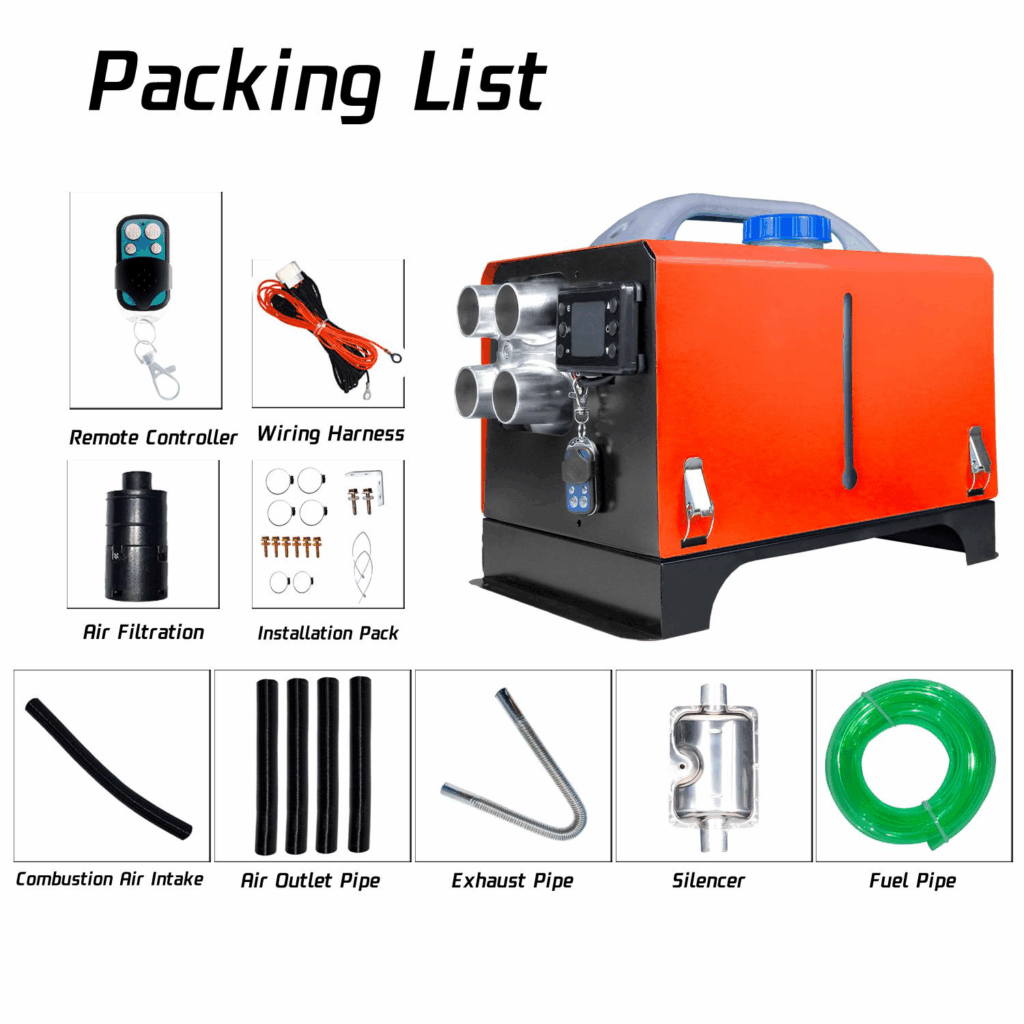
Specifications
| Item | Detail |
|---|---|
| Type | All-in-one horizontal diesel air heater (parking heater) |
| Rated power | 5KW |
| Working voltage | 12V |
| Air outlets | Four outlets, arranged in a 2×2 block, each able to carry a warm-air duct |
| Fuel | Diesel, from the built-in tank on top of the housing |
| Fuel tank capacity | 5L |
| Control | LCD control panel on the housing plus a remote fob |
| Housing | Red and black steel housing, carry handle on top, latch-fastened base plate |
| Fit | 12V trucks, campers and RVs |
| Application | Truck cab, camper cabin |
Questions buyers ask before ordering
Can I run it overnight in the truck cab?
Yes, provided the exhaust is routed outside and the cabin has normal ventilation. Check the unit and the exhaust joint on the first night before you sleep with it running.
Will it drain the vehicle battery?
The blower and the control board run on the vehicle battery, so runtime depends on battery capacity and on the power setting. For long overnight use, a battery with adequate reserve is the practical answer, and a low-voltage cut-off on the supply protects the battery.
Does it work while the engine is off?
Yes. That is the point of a parking heater. The unit has its own combustion chamber, so the engine stays off and the cab still gets warm.
Can it be used in a camper, not just a truck?
Yes, as long as the camper runs a 12V system and the exhaust is taken outside