




未分類

Campers Must-See!2KW Gray All-in-One Diesel Heater: Fuel-Saving, Quiet, Stay Warm on Autumn & Winter Camping Trips

I. The Big Challenge of Autumn & Winter Camping: How to Choose a Heating Device?

1.1 The Persistent Headache of Heating for Campers

Autumn and winter camping is absolutely fantastic! The weather is cool and not stuffy—you can leisurely admire the stunning autumn scenery with forests dyed in layers of red and gold during the day, and lie in the tent to gaze at the starry sky at night. But as night falls, the temperature drops sharply, and heating becomes the top unsolvable problem for all campers. Whether you stay warm directly determines the quality of your camping experience.

The tent gets so cold late at night that you can’t stop shivering, even when wrapped tightly in a sleeping bag. We’ve tried electric heaters, but they drain power banks in less than 30 minutes—far from lasting through the night. Using charcoal for heating is even worse: the thick smoke makes your eyes water, and you have to keep a constant eye on it to prevent sparks from igniting the tent fabric, which poses a huge safety hazard. Don’t worry! Today, we’re thrilled to introduce the new favorite in the camping circle—the 2KW all-in-one diesel heater. It easily solves the heating dilemma of autumn and winter camping, letting you enjoy a warm and comfortable resting time outdoors.

1.2 What is the 2KW All-in-One Camping-Specific Heater?

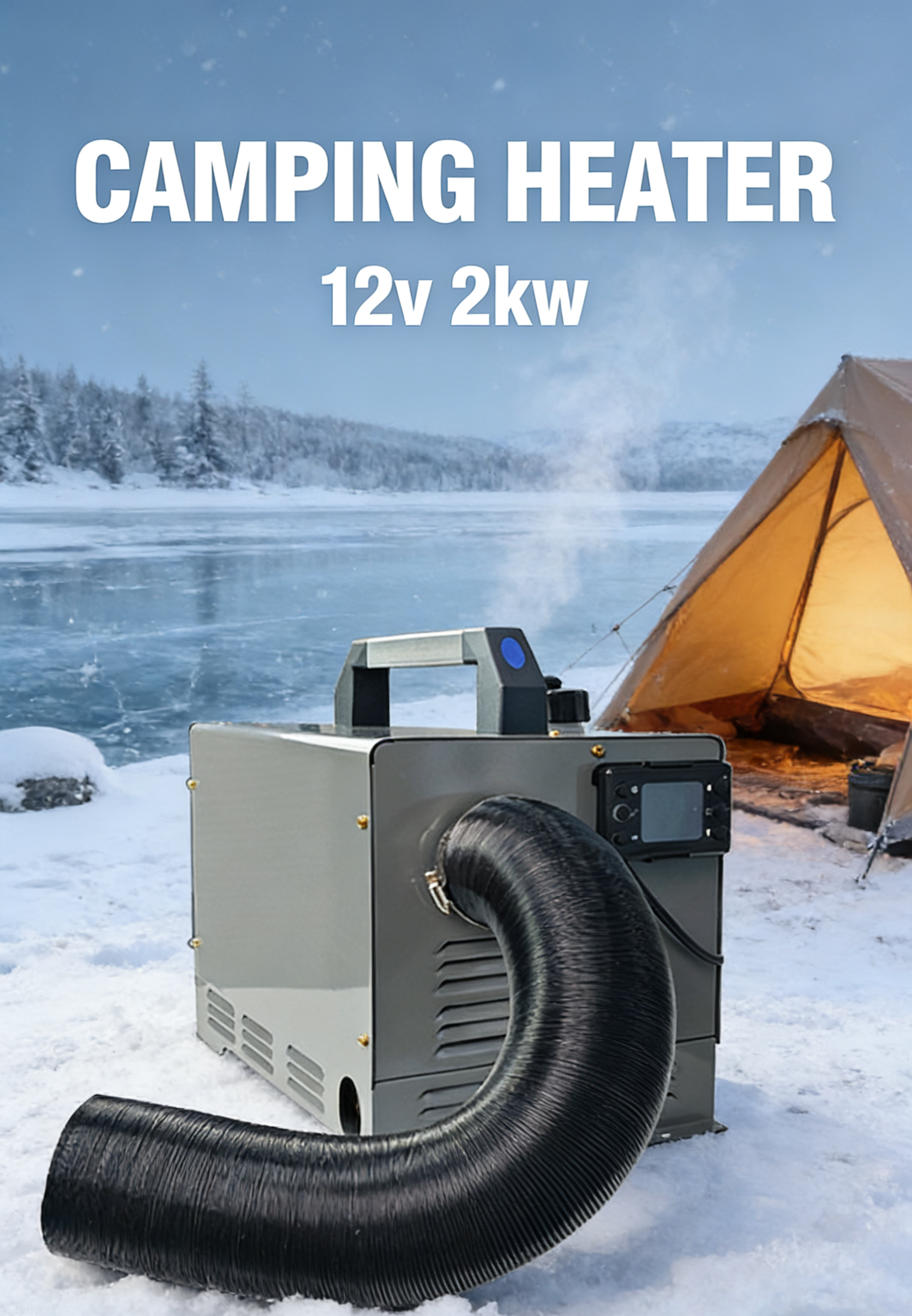
To put it simply, this is a 2KW diesel parking heater all-in-one unit designed specifically for extreme outdoor environments. It boasts super compatibility, supporting not only 12V and 24V vehicle voltages but also 220V household voltage—truly suitable for both vehicle and home use. It focuses on outdoor heating scenarios such as in-car use and camping. Its biggest highlight is that it can operate independently for heating without starting the vehicle, completely freeing you from reliance on the car battery and external power sources. Compact and space-saving, it’s portable and practical—undoubtedly a must-have heating gem for camping!

II. Core Advantages of the 2KW All-in-One Diesel Heater: Why It’s the Top Choice for Camping?

2.1 Fuel-Efficient & Low Consumption, Long Endurance Without Anxiety

Energy consumption is definitely the core concern for campers, and this diesel heater excels in this aspect, perfectly addressing everyone’s worries! According to actual tests by numerous camping enthusiasts, it only consumes 0.3 liters of diesel per hour of continuous operation. Calculated based on an 8-hour heating demand per night, the cost is only about a dozen yuan—much cheaper than staying in a homestay or hotel. Its power consumption is as low as 24 watts, and the energy-saving effect is obvious compared to ordinary electric heaters that often consume thousands of watts. When camping, you only need to carry a small amount of diesel in your backpack to stay warm all night, completely saying goodbye to energy anxiety about outdoor heating.

2.2 Fast Heating & Quiet Operation, Warmth Without Disturbing the Peaceful Moment

Its heating speed is surprisingly powerful—no long wait after turning it on. In just a few minutes, you can feel a steady stream of warm air. What’s more thoughtful is the downward air outlet design, which precisely utilizes the physical principle of hot air rising and cold air sinking. This allows the warm air to circulate naturally in the tent or car, achieving uniform heating throughout the space. There’s no longer the problem of being hot near the heater and cold far away. Most impressively, it operates quietly, with only a faint fan hum—its decibel level is much lower than that of a vehicle at idle or a parking air conditioner. You can barely hear any noise when using it at night, which completely preserves the unique peaceful atmosphere of camping, allowing you to sleep soundly.

2.3 Multi-Scenario Adaptation, Flexible, Convenient & Portable

It’s highly adaptable to various scenarios—whether you’re a RV traveler, an off-road camping enthusiast, or an ordinary tent camper, it fits perfectly. The 12V and 24V vehicle voltages are compatible with most car models, while the 220V household voltage can meet the needs of heating for balcony camping at home, courtyard barbecues, and even serve as an emergency heating device for the home in case of sudden power outages. Adopting an integrated design, it requires no complicated installation process—just unpack it, connect the oil circuit and air outlet, and you’re ready to use it. It’s truly plug-and-play! Compact and lightweight (only a few kilograms), it can be easily stored in the car trunk or camping backpack. Beyond camping, it can also handle temporary heating needs such as ice fishing, outdoor barbecues, and construction site duty with ease.

III. Pros & Cons Roundup: Rational Recommendations, Avoid Pitfalls

3.1 Pros: These Advantages Are Truly Impressive

The core advantages of this diesel heater are clear, each precisely meeting the needs of campers! Firstly, it’s fuel-efficient, low-consumption, and has long endurance. A small amount of diesel can support stable heating for a long time, eliminating the need to frequently find refueling stations—greatly enhancing the convenience of outdoor camping. Secondly, it heats up quickly, operates quietly, and provides uniform heating, which can quickly create a warm and comfortable resting environment without disturbing the peaceful camping atmosphere, significantly improving the overall camping experience. Finally, it has strong multi-scenario adaptability—one device can meet various heating needs for vehicles, outdoors, and homes, making it an indispensable warm companion during camping trips.

What’s more worth mentioning is that many mid-to-high-end models are also equipped with LCD temperature control and remote control functions. When you don’t want to get up while lying in the sleeping bag at night, you can easily adjust the temperature and turn the device on/off with the remote control. The LCD screen clearly displays key information such as the current temperature and remaining fuel, allowing you to keep track of the device’s operating status. It enables precise temperature control and is convenient to use, taking the intelligent user experience to the next level.

3.2 Cons: These Issues Need Attention

Of course, this device isn’t perfect—there are a few minor drawbacks to keep in mind. If you rely entirely on the vehicle battery for power supply and drive short distances every day with insufficient vehicle power generation, it’s easy to cause battery drain, which in turn affects the normal startup of the vehicle. Here’s a small tip: regularly check the battery power status. For long-distance camping, it’s best to prepare an emergency starter power supply to effectively avoid the embarrassment of a dead battery.

Currently, the diesel heater market is mixed with varying product quality. Some low-quality models produced by small workshops may have problems such as poor sealing of oil pipelines and rough component manufacturing, which can easily lead to pipeline leaks. More dangerously, low-quality models have low combustion efficiency—when fuel isn’t fully burned, it produces a large amount of toxic gases such as carbon monoxide. Once accumulated in a confined space, it can easily cause poisoning accidents! Therefore, you must choose regular products with brand qualifications and good reputations, and regularly check the tightness of the pipelines.

Long-term and frequent use of the device will have a slight impact on the service life of the vehicle battery—this impact is more obvious for older batteries with reduced performance. It’s recommended that you use it reasonably according to your camping frequency, pay more attention to the battery’s health status, and replace it with a new one in a timely manner when necessary to avoid affecting normal use.

In addition, slight fuel loss during the use of the device is normal, which is caused by fuel volatilization and pipeline residue. However, if you find that fuel consumption is abnormally rapid—far exceeding the official standard—be sure to stop the device immediately for inspection to check for pipeline leaks or equipment malfunctions, avoiding potential safety hazards.

IV. Horizontal Comparison: 2KW Diesel All-in-One vs Kerosene Heater, Which Is Better?

In the field of outdoor camping heating, the 2KW diesel all-in-one heater and kerosene heater are the two most common choices. Many novice campers struggle to decide which one to pick. Next, we’ll conduct a detailed comparison from core dimensions, clearly presenting the pros and cons of both to help you make an accurate choice without stepping on pitfalls!

4.1 Heating Efficiency & Endurance Cost

First, let’s look at heating efficiency and endurance cost. The advantage of kerosene heaters is that they heat up instantly—you can feel the heat within tens of seconds after turning them on, making them suitable for temporary heating for short periods. However, they have obvious shortcomings: poor long-term heating capacity, difficulty maintaining a stable temperature, and kerosene is much more expensive than diesel. Storage and transportation also require special containers, which are less safe. The cost adds up over long-term use, making them completely unsuitable for camping scenarios that require overnight heating.

Although the initial heating speed of the 2KW diesel all-in-one heater is slightly slower than that of kerosene heaters, it excels in long-lasting and stable heating, able to maintain the set temperature for a long time without sudden temperature fluctuations. With a low consumption rate of only 0.3-0.5 liters of diesel per hour, coupled with the affordable price and easy availability of diesel, as well as more convenient storage and transportation, it has a very obvious advantage in long-term use costs. It perfectly meets the core demand for overnight heating during camping.

4.2 Applicable Scenarios & Durability

Next, let’s examine applicable scenarios and durability. Kerosene heaters are designed to be lightweight, so they are indeed portable, but most of their bodies are made of plastic, resulting in average durability. In complex outdoor environments with vibration, humidity, and low temperatures, they are prone to malfunctions such as component damage and pipeline aging. They are more suitable for simple outdoor activities such as park picnics and short-term outdoor leisure.

In contrast, the 2KW diesel all-in-one heater adopts a high-strength aluminum alloy body, which is structurally sturdy and has excellent vibration resistance, moisture resistance, and low-temperature resistance. It can easily adapt to the complex and harsh environments of wild camping. Coupled with its multi-voltage adaptation design, it can be perfectly used in various camping scenarios such as RVs, tents, and off-road vehicles. Whether for long-term outdoor camping or occasional short trips, it can perform stably—outperforming kerosene heaters in both durability and practicality.

V. Safe Usage Tips: Heating Safety Guide, Don’t Ignore These Details

When it comes to outdoor heating, safety is always the top priority! Although this diesel heater is easy to use, you must strictly abide by safety regulations when using it. These key usage tips must be kept in mind to avoid safety accidents!

5.1 Before Use: Ensure Proper Installation & Inspection

Thorough installation and inspection before use are the foundation of safety. First, carefully check for damage or deformation of the device body and aging or cracking of the oil pipelines. Then, inspect the tightness of the pipeline connections to ensure there are no loosening or leakage issues. Secondly, the exhaust outlet must be extended to an area far away from the camping site using a dedicated extension pipeline, preferably downwind, to prevent exhaust gas from spreading to the resting area and causing pollution. In addition, if you’re using an older vehicle or RV, carefully check for rust holes at the junction of the cab and the carriage. If any problems are found, seal them with sealant in a timely manner to prevent exhaust gas from leaking into the carriage.

5.2 During Use: Never Cross These Red Lines

There are several red lines you must never cross during use!

First, strictly prohibit use in completely enclosed spaces! Whether it’s a tent or a car, you must leave a 5-10 cm gap in the window for ventilation to maintain air circulation. This can effectively discharge gases such as carbon dioxide and carbon monoxide produced by combustion, preventing poisoning accidents. Never take chances and think “it’s okay to use it for a while.”

Second, always use pure anti-freeze diesel. Low-quality diesel or ordinary diesel is prone to waxing in low-temperature environments, which can clog the oil circuit and affect the device’s operation. Remember to prepare an adequate amount of backup fuel in advance when camping to avoid equipment shutdown due to lack of fuel halfway.

Third, when parking for heating, always choose a well-ventilated and open area, away from flammable materials such as dry grass, fallen leaves, and tent fabric. Keep a safety distance of at least 1 meter around the device to eliminate fire hazards.

VI. Conclusion: For Autumn & Winter Camping Heating, This Is the One!

Overall, with its core advantages of fuel efficiency, low consumption, fast heating, quiet operation, and multi-scenario adaptation, the 2KW all-in-one diesel heater perfectly solves the heating problem of autumn and winter camping. It allows campers to no longer give up wonderful outdoor experiences due to cold weather. Whether you’re a full-time RV traveler or a tent camper who enjoys occasional short trips, this heating essential can accurately meet your needs—it’s a must-have warm gear for autumn and winter camping!